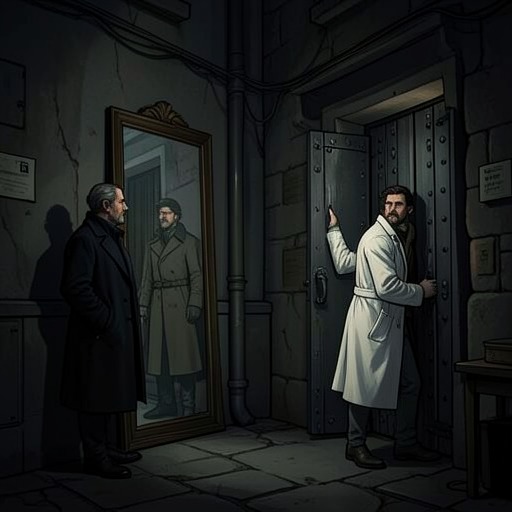
Mr. Hollaby
Partners in CrimeMr. Hollaby, Captain Sessle’s friend and business partner, becomes central to the mystery of Sessle’s murder because he is both the last person known to have seen him alive and the witness whose account helps shape the investigation. When the company’s financial fraud comes to light, Tommy reconsiders the apparent alibi: the elder Hollaby may have been keeping suspicion away from his son, whom Tommy identifies as a plausible suspect.
Identity and Business Connection
Mr. Hollaby is associated with the Porcupine Assurance Co. as Sessle’s business partner. He and Sessle played golf together on the day Sessle died, making Hollaby a significant witness to the victim’s final hours. Tommy later says that investigators had long been uneasy about the company’s figures and suspicious of the Hollabys, though they had lacked evidence.
The company’s liquidation and the discovery of extensive misappropriation give the murder a financial context. Tommy reasons that Sessle had been embezzling money and was close to exposure and ruin. He says neither Hollaby nor Hollaby’s son knew what Sessle had been doing; the two Hollabys were left practically ruined by the scandal. That reported ignorance does not settle the question of who killed Sessle, but it places Hollaby within a business relationship marked by concealed financial wrongdoing and severe consequences.
The Golf-Course Account
Hollaby’s account places him with Sessle during an earlier round of golf and again later that day. After tea, he agreed to play several more holes before darkness made the course difficult to see. As the pair approached the sixth green, Hollaby noticed a tall woman dressed in brown on a public footpath crossing the links, though he said he paid her little attention and believed Sessle had not noticed her.
The woman was waiting near the far side of the seventh tee when Sessle arrived ahead of Hollaby. Hollaby said that, as he came closer, he saw Sessle talking with her. The two turned abruptly, and Sessle called over his shoulder that he would not be long. This encounter makes Hollaby the source of the account that introduces the mysterious woman in brown, whose connection with the murder remains unexplained in the evidence presented here.
Suspicion and the Son’s Possible Role
Tommy challenges the weight given to Hollaby’s apparent alibi. In his reconstruction, Hollaby knew that the man playing with him was not really Sessle, despite the distinctive blue golf coat. Tommy proposes that Hollaby and his son were the actual embezzlers, and argues that the killer would have needed close knowledge of Sessle’s household: the servants were routinely away on Wednesdays, Sessle’s wife was absent, and the killer could obtain an impression of Sessle’s latch key.
Tommy considers Hollaby’s son a better fit for those requirements. He was about Sessle’s age and height, and both men were clean-shaven, making substitution plausible. Doris Evans might have seen newspaper photographs of Sessle, Tommy notes, but such images would have shown little beyond the fact that the figure was a man. The son had not appeared in court, while the elder Hollaby, backed by what Tommy calls an irreproachable alibi, had remained in the public eye. No one, Tommy points out, had even asked what the son was doing on the evening of the murder.
Investigation and Unresolved Outcome
Inspector Marriot confirms that the police had suspicions about the Hollabys and the Porcupine Assurance Co.’s accounts, but had found nothing on which to act. Tommy’s theory gives them a new investigative step: Marriot says the police will confront the younger Hollaby with Doris Evans and see whether she recognizes him. He credits the detectives’ insight about the blue coat to Blunt’s Brilliant Detectives.
The supplied account ends with that proposed confrontation, not with its result. It therefore establishes neither Hollaby’s guilt nor the son’s guilt as a final finding. Instead, Hollaby’s importance lies in the gap between his credible public position as the last witness and Tommy’s suspicion that the apparent alibi concealed a substitution—and protected the younger man from scrutiny.